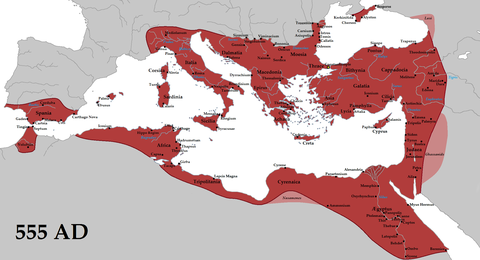
◊ While the Byzantine Roman and Sassanid Persian empires were both weakened by warfare (602–628), a new power in the form of Islam grew in the Middle East. In a series of rapid Muslim conquests, Arab armies, led by the Caliphs and skilled military commanders such as Khalid ibn al-Walid, swept through most of the Middle East, taking more than half of Byzantine territory and completely engulfing the Persian lands. In Anatolia, they were stopped in the Siege of Constantinople (717–718) by the Byzantines, who were helped by the Bulgarians.
The Byzantine provinces of Roman Syria, North Africa, and Sicily, however, could not mount such a resistance, and the Muslim conquerors swept through those regions. At the far west, they crossed the sea taking Visigothic Hispania before being halted in southern France in the Battle of Tours by the Franks. At its greatest extent, the Arab Empire was the first empire to control the entire Middle East, as well three-quarters of the Mediterranean region, the only other empire besides the Roman Empire to control most of the Mediterranean Sea. It would be the Arab Caliphates of the Middle Ages that would first unify the entire Middle East as a distinct region and create the dominant ethnic identity that persists today. The Seljuq Empire would also later dominate the region.