◊ The modern Middle East was shaped by three things: departure of European powers, the founding of Israel, and the growing importance of the oil industry. These developments led increased U.S. involvement in Middle East. The United States was the ultimate guarantor of the region’s stability as well as the dominant force in the oil industry after the 1950s. When revolutions brought radical anti-Western regimes to power in Egypt (1954), Syria (1963), Iraq (1968), and Libya (1969), the Soviet Union, seeking to open a new arena of the Cold War, allied itself with Arab socialist rulers like Gamal Abdel Nasser in Egypt and Saddam Hussein in Iraq.
These regimes gained popular support with promises to destroy the state of Israel, defeat the United States and other “western imperialists”, and to bring prosperity to the Arab masses. When the Six-Day War of 1967 with Israel ended in a decisive loss for the Muslim side, many viewed defeat as the failure of Arab socialism. This represents a turning point when “fundamental and militant Islam began to fill the political vacuum created”.
The United States, in response, felt obliged to defend its remaining allies, the conservative monarchies of Saudi Arabia, Jordan, Iran, and the Persian Gulf emirates, whose methods of rule were almost as unattractive in western eyes as those of the anti-western regimes. Iran in particular became a key U.S. ally, until a revolution led by the Shi’a clergy overthrew the monarchy in 1979 and established a theocratic regime that was even more anti-western than the secular regimes in Iraq or Syria. This forced the United States into a close alliance with Saudi Arabia. The list of Arab-Israeli wars includes a great number of major wars such as 1948 Arab–Israeli War, 1956 Suez War, 1967 Six-Day War, 1970 War of Attrition, 1973 Yom Kippur War, 1982 Lebanon War, as well as a number of lesser conflicts.
In Cyprus between 1955 and 1974, conflict arising between Greek Cypriots and Turkish Cypriots led to Cypriot intercommunal violence and the Turkish invasion of Cyprus. The Cyprus dispute remains unresolved.
In the mid-to-late 1960s, the Arab Socialist Ba’ath Party led by Michel Aflaq and Salah al-Din al-Bitar took power in both Iraq and Syria. Iraq was first ruled by Ahmed Hassan al-Bakr, but was succeeded by Saddam Hussein in 1979, and Syria was ruled first by a Military Committee led by Salah Jadid, and later Hafez al-Assad until 2000, when he was succeeded by his son, Bashar al-Assad.
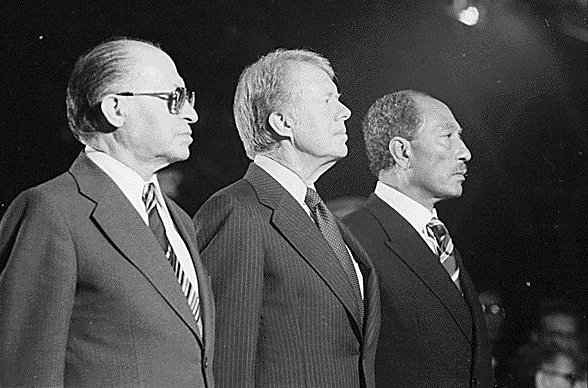
In 1979, Egypt under Nasser’s successor, Anwar Sadat, concluded a peace treaty with Israel, ending the prospects of a united Arab military front. From the 1970s the Palestinians, led by Yasser Arafat’s Palestine Liberation Organization, resorted to a prolonged campaign of violence against Israel and against American, Jewish, and western targets generally, as a means of weakening Israeli resolve and undermining western support for Israel. The Palestinians were supported in this, to varying degrees, by the regimes in Syria, Libya, Iran, and Iraq. The high point of this campaign came in the 1975 United Nations General Assembly Resolution 3379 condemning Zionism as a form of racism and the reception given to Arafat by the United Nations General Assembly. Resolution 3379 was revoked in 1991 by the United Nations General Assembly Resolution 4686.
Due to many of the frantic events of the late 1970s in the Middle East it culminated in the Iran–Iraq War between neighboring Iran and Iraq. The war, started by Iraq, who invaded Iranian Khuzestan in 1980 at the behest of the latter’s chaotic state of country due to the 1979 Islamic Revolution, eventually turned into a stalemate with hundreds of thousands of dead on both sides.
The fall of the Soviet Union and the collapse of communism in the early 1990s had several consequences for the Middle East. It allowed large numbers of Soviet Jews to emigrate from Russia and Ukraine to Israel, further strengthening the Jewish state. It cut off the easiest source of credit, armaments, and diplomatic support to the anti-western Arab regimes, weakening their position. It opened up the prospect of cheap oil from Russia, driving down the price of oil and reducing the west’s dependence on oil from the Arab states. It discredited the model of development through authoritarian state socialism, which Egypt (under Nasser), Algeria, Syria, and Iraq had followed since the 1960s, leaving these regimes politically and economically stranded. Rulers such as Iraq’s Saddam Hussein increasingly relied on Arab nationalism as a substitute for socialism.
Saddam Hussein led Iraq into a prolonged and costly war with Iran from 1980 to 1988, and then into its fateful invasion of Kuwait in 1990. Kuwait had been part of the Ottoman province of Basra before 1918, and thus in a sense part of Iraq, even though Iraq had recognized its independence in 1961. In response, the United States formed a coalition of allies with Saudi Arabia, Egypt, and Syria, gained UN approval, and evicted Iraq from Kuwait by force in the Gulf War. President George H. W. Bush did not, however, attempt to overthrow Saddam Hussein, which the United States later came to regret. The Gulf War led to a permanent U.S. military presence in the Persian Gulf, particularly in Saudi Arabia, which offended many Muslims, and was a reason often cited by Osama bin Laden as justification for the September 11 attacks.