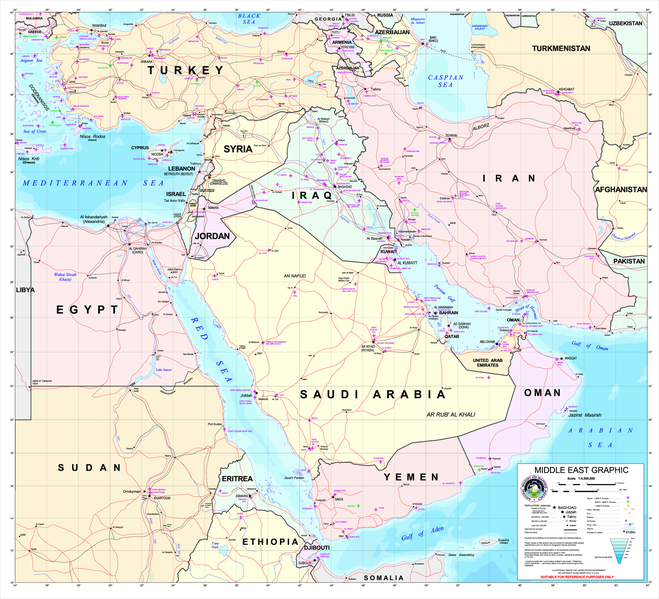
◊ The worldwide change of governance in Eastern Europe, Latin America, East Asia, and parts of Africa following the dissolution of the Soviet Union did not occur in the Middle East. In the whole region, only Israel, Turkey and to some extent Lebanon and the Palestinian territories were considered to be democracies. Some countries had legislative bodies, but these were said to have little power. In the Persian Gulf states the majority of the population could not vote because they were guest workers rather than citizens.
In most Middle Eastern countries, the growth of market economies was said to be limited by political restrictions, corruption, and cronyism, overspending on arms and prestige projects and over-dependence on oil revenues. The successful economies were countries that had oil wealth and low populations, such as Qatar, Bahrain, Kuwait and the United Arab Emirates, where the ruling emirs allowed some political and social liberalization, but without giving up any of their own power. Lebanon also rebuilt a fairly successful economy after a prolonged civil war in the 1980s.
At the beginning of the 21st century, all these factors intensified conflict in the Middle East, which affected the entire world. Bill Clinton’s failed attempt to broker a peace deal between Israel and Palestine at the Camp David Summit in 2000 led directly to the election of Ariel Sharon as Prime Minister of Israel and to the Second Intifada, which conducted suicide bombings on Israeli civilians. This was the first major outbreak of violence since the Oslo Peace Accords of 1993.
At the same time, the failures of most of the Arab governments and the bankruptcy of secular Arab radicalism led a section of educated Arabs (and other Muslims) to embrace Islamism, promoted both by Iran’s Shi’a clerics as well as by Saudi Arabia’s powerful Wahhabist sect. Many of the militant Islamists gained their military training while fighting Soviet forces in Afghanistan. Many of the Afghan jihadists, though supposedly none of the Arab volunteers, were funded by the United States under Operation Cyclone as part of the Reagan Doctrine, one of the longest and most expensive CIA covert operations ever.
One of these Arab militants was a wealthy Saudi Arabian named Osama bin Laden. After fighting against the Soviets in Afghanistan in the 1980s, he formed the al-Qaida organization, which was responsible for the 1998 U.S. embassy bombings, the USS Cole bombing and the September 11, 2001 attacks on the United States. The September 11 attacks led the George W. Bush administration to invade Afghanistan in 2001 to overthrow the Taliban regime, which had been harboring Bin Laden and al-Qaida. The United States and its allies described this operation as part of a global “War on Terror”.
In 2002, U.S. Defense Secretary Donald Rumsfeld developed a plan to invade Iraq, remove Saddam from power, and turn Iraq into a democratic state with a free-market economy, which they hoped would serve as a model for the rest of the Middle East. The United States and its principal allies—Britain, Italy, Spain, and Australia—could not secure United Nations approval for the execution of the numerous UN resolutions, so they launched an invasion of Iraq and deposed Saddam without much difficulty in April 2003.
The advent of a new western army of occupation in a Middle Eastern capital marked a turning point in the history of the region. Despite successful elections (although boycotted by large portions of Iraq’s Sunni population) held in January 2005, much of Iraq had all but disintegrated, due to a post-war insurgency which morphed into persistent ethnic violence that the American army was initially unable to quell. Many of Iraq’s intellectual and business elite fled the country, and many Iraqi refugees left as a result of the insurgency, further destabilizing the region. A responsive surge in U.S. forces in Iraq was largely successful in controlling the insurgency and stabilizing the country. U.S. forces withdrew from Iraq by December 2011.
By 2005, President George W. Bush’s Road map for peace between Israel and the Palestinians was stalled, although this situation had begun to change with Yasser Arafat’s death in 2004. In response, Israel moved towards a unilateral solution, pushing ahead with the Israeli West Bank barrier to protect Israel from Palestinian suicide bombers and proposed unilateral withdrawal from Gaza. In 2006 a new conflict erupted between Israel and Hezbollah Shi’a militia in southern Lebanon, further setting back any “prospects for peace”.
In the early 2010s, a revolutionary wave popularly known as the Arab Spring brought major protests, uprisings, and revolutions to several Middle Eastern countries, followed by prolonged civil wars in Syria, Iraq, Yemen, and Libya. In 2014, a terrorist group and self-proclaimed caliphate calling itself the Islamic State made rapid territorial gains in western Iraq and eastern Syria, prompting international military intervention. At its peak, the group controlled an area containing an estimated 2.8 to 8 million people, 98% of which was lost by December 2017.