◊ In 1878, as the result of the Cyprus Convention, the United Kingdom took over the government of Cyprus as a protectorate from the Ottoman Empire. While the Cypriots at first welcomed British rule, hoping that they would gradually achieve prosperity, democracy and national liberation, they soon became disillusioned. The British imposed heavy taxes to cover the compensation they paid to the Sultan for conceding Cyprus to them. Moreover, the people were not given the right to participate in the administration of the island, since all powers were reserved to the High Commissioner and to London.
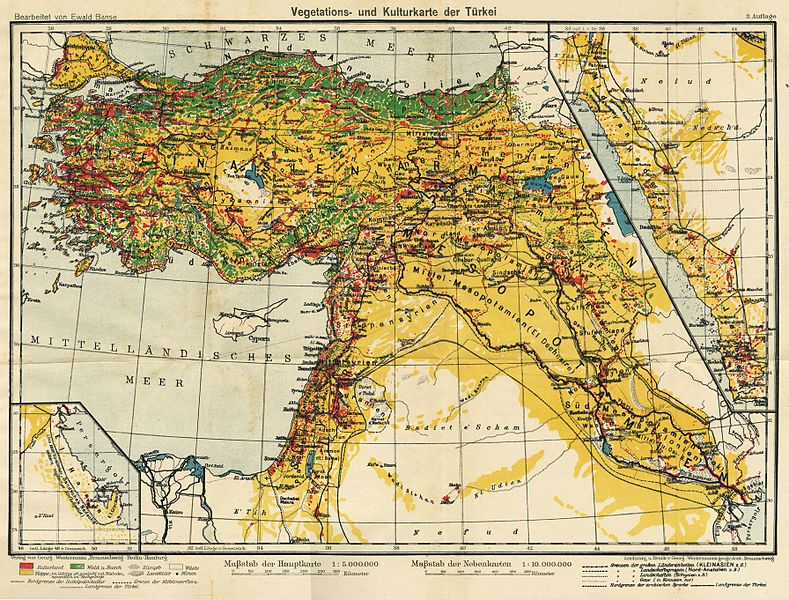
Meanwhile, the fall of the Ottomans and the partitioning of Anatolia by the Allies led to resistance by the Turkish population, under the Turkish National Movement led by Mustafa Kemal Atatürk, the Turkish victory against the invading powers during the Turkish War of Independence, and the founding of the modern Republic of Turkey in 1923.
As the first President of Turkey, Atatürk embarked on a program of modernization and secularization. He abolished the caliphate, emancipated women, enforced western dress and the use of a new Turkish alphabet based on Latin script in place of the Arabic alphabet, and abolished the jurisdiction of the Islamic courts. In effect, Turkey, having given up rule over the Arab world, was now determined to secede from the Middle East and become culturally part of Europe.
Another turning point came when oil was discovered, first in Persia (1908) and later in Saudi Arabia (1938) as well as the other Persian Gulf states, Libya, and Algeria. The Middle East, it turned out, possessed the world’s largest easily accessible reserves of crude oil, the most important commodity in the 20th century. While western oil companies pumped and exported nearly all of it to fuel the rapidly expanding automobile industry among other developments, the kings and emirs of these oil states became immensely rich, allowing them to consolidate their hold on power and giving them a stake in preserving western hegemony over the region.
A Western dependence on Middle Eastern oil and the decline of British influence led to a growing American interest in the region. Initially, the Western oil companies established a dominance over oil production and extraction. However, indigenous movements towards nationalizing oil assets, oil sharing, and the advent of OPEC ensured a shift in the balance of power towards the Arab oil states.
Oil wealth also had the effect of suffocating whatever economic, political, or social reform might have emerged in the Arab world under the influence of the Kemalist revolution in Turkey.