◊ The Ottoman Empire (1299–1918):
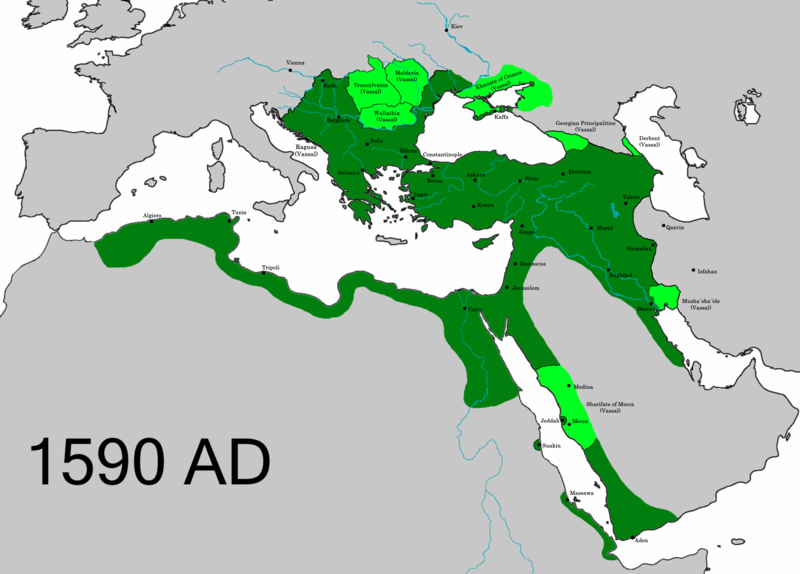
By the early 15th century, a new power had arisen in western Anatolia, the Ottoman Empire. Ottoman khans, who in 1453 captured the Christian Byzantine capitol of Constantinople and made themselves sultans. The Mamluks held the Ottomans out of the Middle East for a century, but in 1514 Selim the Grim began the systematic Ottoman conquest of the region. Syria was occupied in 1516 and Egypt in 1517, extinguishing the Mameluk line. Iraq was conquered almost in 40 years from the Iranian Safavids, who were successors of the Aq Qoyunlu.
The Ottomans united the whole region under one ruler for the first time since the reign of the Abbasid caliphs of the 10th century, and they kept control of it for 400 years, despite brief intermissions created by the Iranian Safavids and Afsharids. By this time the Ottomans also held Greece, the Balkans, and most of Hungary, setting the new frontier between east and west far to the north of the Danube.
In the west, Europe was rapidly expanding, demographically, economically, and culturally. By 1700, the Ottomans had been driven out of Hungary. Although some areas of Ottoman Europe, such as Albania and Bosnia, saw many conversions to Islam, the area was never culturally absorbed into the Muslim world. From 1768 to 1918, the Ottomans gradually lost territory. By the 19th century, Europe had overtaken the Muslim world in wealth, population, and—most importantly—technology. The industrial revolution fueled a boom that laid the foundations for the growth of capitalism. During the 19th century, Greece, Serbia, Romania, and Bulgaria claimed independence, and the Ottoman Empire became known as the “sick man of Europe”, increasingly under the financial control of European powers. Domination soon turned to outright conquest: the French annexed Algeria in 1830 and Tunisia in 1878 and the British occupied Egypt in 1882, though it remained under nominal Ottoman sovereignty. In the Balkan Wars of 1912–13 the Ottomans were driven out of Europe altogether, except for the city of Constantinople and its hinterland.
The British also established effective control of the Persian Gulf, and the French extended their influence into Lebanon and Syria. In 1912, the Italians seized Libya and the Dodecanese islands, just off the coast of the Ottoman heartland of Anatolia. The Ottomans turned to Germany to protect them from the western powers, but the result was increasing financial and military dependence on Germany.