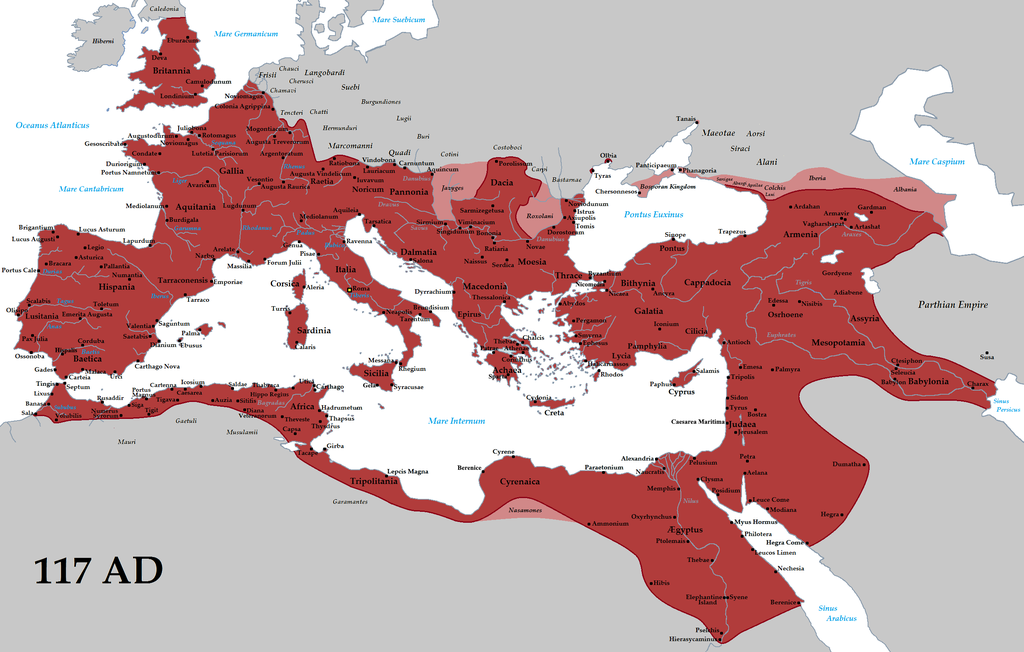
◊ In 66–63 BC, the Roman general Pompey conquered much of the Middle East. The Roman Empire united the region with most of Europe and North Africa in a single political and economic unit. Even areas not directly annexed were strongly influenced by the Empire, which was the most powerful political and cultural entity for centuries. Though Roman culture spread across the region, the Greek culture and language first established in the region by the Macedonian Empire continued to dominate throughout the Roman period. Cities in the Middle East, especially Alexandria, became major urban centers for the Empire and the region became the Empire’s “bread basket” as the key agricultural producer. Ægyptus was by far the most wealthy Roman province.
As the Christian religion spread throughout the Roman and Persian Empires, it took root in the Middle East, and cities such as Alexandria and Edessa became important centers of Christian scholarship. By the 5th century, Christianity was the dominant religion in the Middle East, with other faiths (gradually including heretical Christian sects) being actively repressed. The Middle East’s ties to the city of Rome were gradually severed as the Empire split into East and West, with the Middle East tied to the new Roman capital of Constantinople. The subsequent Fall of the Western Roman Empire therefore, had minimal direct impact on the region.