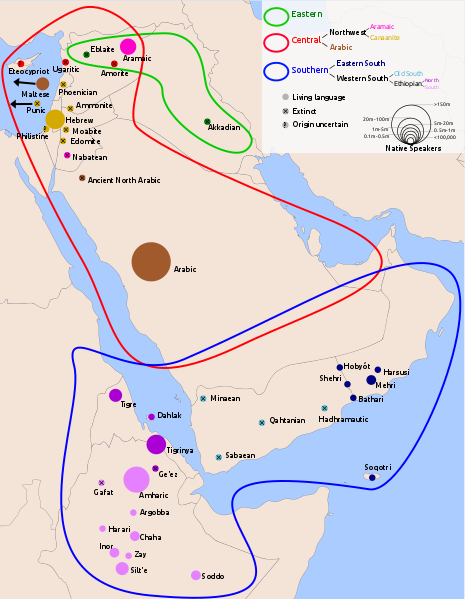
◊ Since ancient times the Middle East has had several lingua franca: Akkadian (c. 14th–8th century BC), Aramaic (c. 8th century BC – 8th century AD), Greek (c. 4th century BC – 8th century AD), and Arabic (c. 8th century AD – present). Familiarity with English is not uncommon among the middle and upper classes. Arabic is not commonly spoken in Turkey, Iran, and Israel, and some varieties of Arabic lack mutual intelligibility, thus qualifying as distinct languages by this linguistic criterion.
The Middle East was the birthplace of the Abrahamic, Gnostic, and most Iranian religions. Initially the ancient inhabitants of the region followed various ethnic religions, but most of those began to be gradually replaced at first by Christianity (even before the 313 AD Edict of Milan) and finally by Islam (after the spread of the Muslim conquests beyond the Arabian Peninsula in 634 AD). To this day, however, the Middle East has, in particular, some sizable, ethnically distinct Christian minority groups, as well as Jews, concentrated in Israel, and followers of Iranian religions, such as Yazdânism and Zoroastrianism. Some of the smaller ethnoreligious minorities include the Shabak people, the Mandaeans and the Samaritans. It is somewhat controversial whether the Druze religion is a distinct religion in its own right or merely a part of the Ismailist branch of Shia Islam.