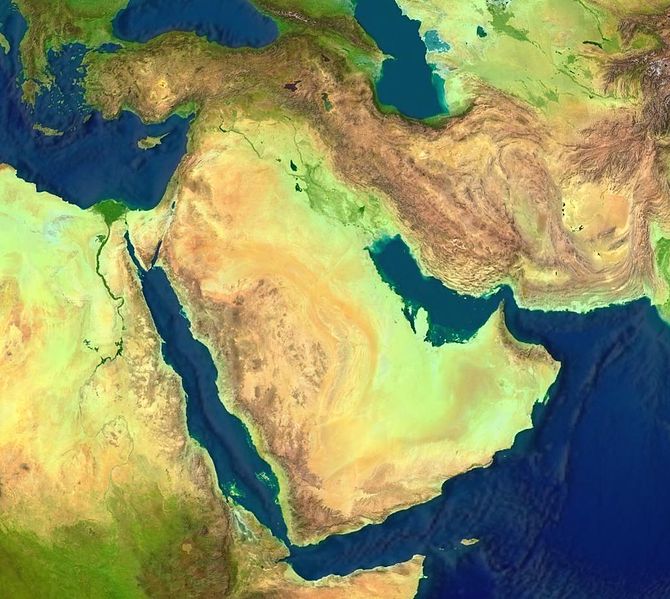
◊ Geographically, the Middle East can be thought of as Western Asia with the addition of Egypt (which is the non-Maghreb region of Northern Africa) and with the exclusion of the Caucasus. The Middle East was the first to experience a Neolithic Revolution (c. the 10th millennium BCE), as well as the first to enter the Bronze Age (c. 3300–1200 BC) and Iron Age (c. 1200–500 BC).
Historically human populations have tended to settle around bodies of water, which is reflected in modern population density patterns. Irrigation systems were extremely important for the agricultural Middle East: for Egypt that of the lower Nile River, and for Mesopotamia that of the Tigris and Euphrates rivers. Levantine agriculture depended on precipitation rather than on the river-based irrigation of Egypt and Mesopotamia, resulting in preference for different crops. Since travel was faster and easier by sea, civilizations along the Mediterranean, such as Phoenicia and later Greece, participated in intense trade. Similarly, Ancient Yemen, much more conducive to agriculture than the rest of the Arabian Peninsula, sea traded heavily with the Horn of Africa, some of which it lingually Semitized. The Adnanite Arabs, inhabiting the drier desert areas of the Middle East, were all nomadic pastoralists before some began settling in city states, with the geo-linguistic distribution today being divided between Persian Gulf, the Najd and the Hejaz in the Peninsula, as well as the Bedouin areas beyond the Peninsula.