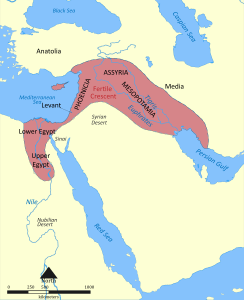
◊ The cultural stage of civilization (organized society structured around urban centers) first arises in Southwest Asia, as an extension of the Neolithic trend, from as early as the 8th millennium BC, of proto-urban centers such as Çatal Hüyük. Urban civilizations proper begin to emerge in the Chalcolithic, in 5th-to-4th-millennium Egypt, and in Mesopotamia.
Gold artifacts in the Balkans appear from the 4th millennium BC, such as those found in a burial site from 4569–4340 BC and one of the most important archaeological sites in world prehistory – the Varna Necropolis near Lake Varna in Bulgaria, thought by one source (La Niece 2009) to be the earliest “well-dated” find of gold artifacts. As of 1990, gold artifacts found at the Wadi Qana cave cemetery of the 4th millennium BC in the West Bank were the earliest from the Levant.
The Bronze Age arises in this region during the final centuries of the 4th millennium. The urban civilizations of the Fertile Crescent now have writing systems and developed bureaucracy, by the mid-3rd millennium leading to the development of the earliest empires. In the 2nd millennium, the eastern coastlines of the Mediterranean are dominated by the Hittite and Egyptian empires, competing for control over the city-states in the Levant (Canaan). The Minoans are trading throughout much of the Mediterranean.
The Bronze Age collapse is the transition from the Late Bronze Age to the Early Iron Age, expressed by the collapse of palace economies of the Aegean and Anatolia, which were replaced after a hiatus by the isolated village cultures of the ancient Near East. Some have gone so far as to call the catalyst that ended the Bronze Age a “catastrophe”. The Bronze Age collapse may be seen in the context of a technological history that saw the slow, comparatively continuous spread of iron-working technology in the region, beginning with precocious iron-working in what is now Romania in the 13th and 12th centuries. The cultural collapse of the Mycenaean kingdoms, the Hittite Empire in Anatolia and Syria, and the Egyptian Empire in Syria and Israel, the scission of long-distance trade contacts, and the sudden eclipse of literacy occurred between 1206 and 1150 BC. In the first phase of this period, almost every city between Troy and Gaza was violently destroyed, and often left unoccupied thereafter (for example, Hattusas, Mycenae, Ugarit). The gradual end of the Dark Age that ensued saw the rise of settled Neo-Hittite Aramaean kingdoms of the mid-10th century BC, and the rise of the Neo-Assyrian Empire.
While the cultural advances during the Bronze Age had mostly been confined to the eastern parts of the Mediterranean, with the Iron Age, the entire coastal region surrounding the Mediterranean now becomes involved, significantly due to the Phoenician expansion from the Levant, beginning in ca. the 12th century. Fernand Braudel remarked in The Perspective of the World that Phoenicia was an early example of a “world-economy” surrounded by empires. The high point of Phoenician culture and sea power is usually placed ca. 1200–800 BC. Many of the most important Phoenician settlements had been established long before this: Byblos, Tyre, Sidon, Simyra, Arwad, and Berytus, all appear in the Amarna tablets.
The Phoenicians and the Assyrians transported elements of the Late Bronze Age culture of the Near East to Iron Age Greece and Italy, but also further afield to Northwestern Africa and to Iberia, initiating the beginning of Mediterranean history now known as Classical Antiquity. They notably spread alphabetic writing, which would become the hallmark of the Mediterranean civilizations of the Iron Age, in contrast to the cuneiform writing of Assyria and the logographic system in the Far East (and later the abugida systems of India).